

The RHS Chelsea Flower Show 2026 Trends That Will Shape Our Gardens Next
Every year, the RHS Chelsea Flower Show gives us a glimpse into where garden design is heading. Some trends disappear quickly, but others reflect much deeper cultural and environmental shifts that go on to shape gardens for years afterwards.
Yesterday I gave a talk at the Lindley Library for the RHS on Chelsea trends and inspiration for your garden. Chelsea is a fascinating mirror of where things are going and, as a society, how we view ourselves and our relationship with nature. It has been doing this for well over 100 years. I’ve been reflecting on the ideas that feel most significant this year, not just aesthetically, but socially and environmentally too.
What stood out most strongly at Chelsea this year was a continued move away from polished uniformity and floristry towards gardens that feel more adaptive, ecological and grounded. For me, this reflects a wider shift, one I fully endorse and actively push in my own work, that the pinnacle of horticulture and garden design is not about control, uniformity or rigid perfection, but about the richness of the relationship you build with the land around you.
1. Planting Is Becoming More Diverse, and Soil Is Changing Too
One of the clearest shifts at Chelsea is the growing move away from traditional soil or compost conditions towards much more varied substrate planting.
For years, many gardens relied heavily on rich soil improved with organic matter and topped with woodland mulch. Increasingly though, designers are experimenting with mineral based growing mediums, sands, gravels and leaner substrates that support entirely different plant communities and are, long term, less consumptive.
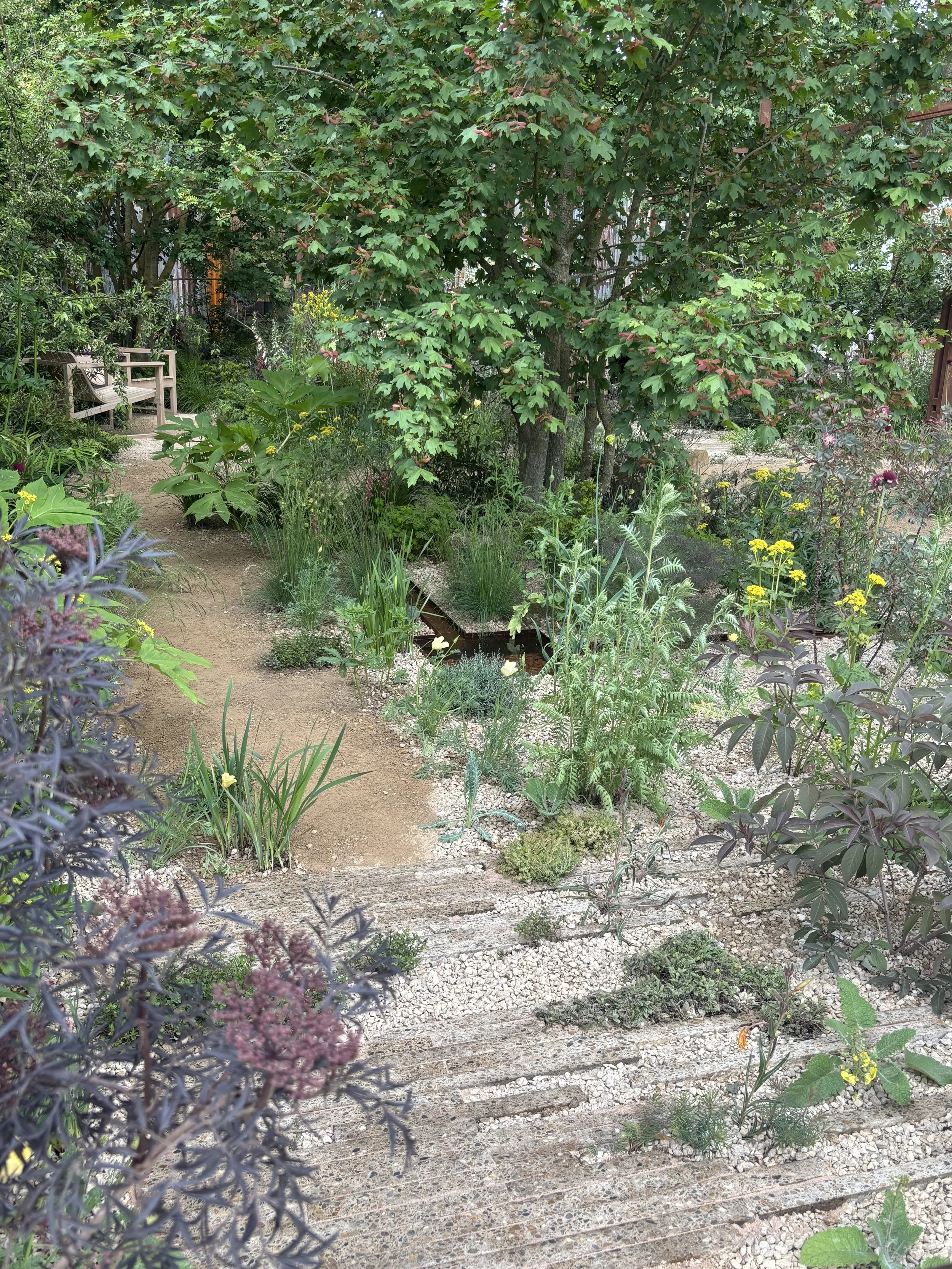
The Children’s Society Garden designed by Patrick Clarke who has experimented with a variety of substrates in his garden.
This reflects, I feel, the changing climate and the need to plan for the aesthetics of the future. Longer dry periods, hotter summers and more unpredictable rainfall mean many traditional planting approaches are becoming harder to sustain long term and increasingly labour intensive. Designers are responding by exploring plants adapted to tougher and more extreme conditions.
The late Professor Nigel Dunnett’s 2025 Chelsea garden demonstrated this beautifully through planting established in sand based growing conditions inspired by coastal landscapes. The garden explored how mineral substrates can support more resilient and diverse planting communities.
This direction has also been explored for years through the work of designers and plantsmen such as James Hitchmough, whose research into meadow and substrate planting has profoundly influenced contemporary naturalistic design. At Knepp Estate, rewilding approaches continue to challenge assumptions around what successful planting should look like, while Tom Stuart-Smith’s ongoing planting trials are helping shape how designers think about drought resilience and plant communities for the future. Half of his trial planting is grown in sand.
Rather than fighting climate conditions, gardens are increasingly adapting to them. I was profoundly moved by the passing of Nigel Dunnett, who I had a very moving conversation with last year about this very subject. Discussing both of our Chelsea gardens, we agreed that it is no longer enough to simply say “right plant, right place”. We also need to think about the right aesthetic for the right location. Everything needs to be considered.
That means we are likely to see:
more gravel and sand based planting
drought tolerant species
looser planting communities
self seeding behaviour and less formal block planting
more experimental plant palettes
reduced irrigation demand
The result is often a garden that feels more dynamic, seasonal and ecologically alive. That said, this style requires care in a different way, with an artful eye to seasonally edit and rebalance planting to maintain overall harmony and composition.
2. Trees Are Becoming More Characterful and Less Manicured
Another major shift I noticed this year was the way trees are being used. For years, many urban gardens, and Chelsea itself, leaned heavily on tightly clipped forms, perfect avenue planting and uniform multi stem specimens arranged almost architecturally. That aesthetic is beginning to soften.
For the past half decade, the multi stem tree has reigned supreme in urban garden design, but I would argue this Chelsea saw unmanicured trees push the idea one step further.
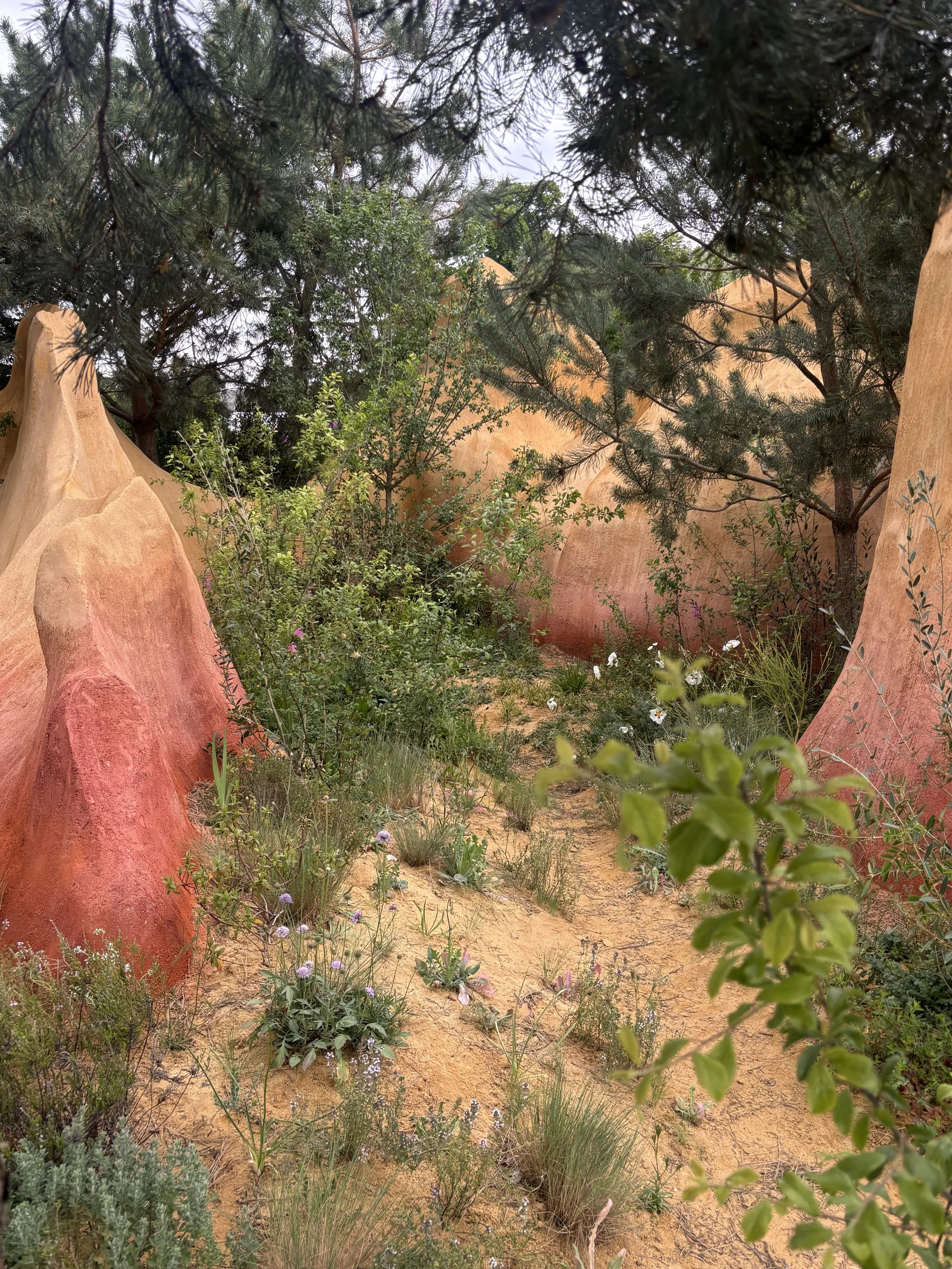
The Project Giving Back garden - showing highly characterful pine trees and windswept shrubs, designed by James Basson
At Chelsea this year, trees felt far more individual and expressive. Irregular canopies, asymmetrical forms and trees with visible age and movement appeared repeatedly across the show gardens. Even where designers used structural planting, there was often a greater willingness to embrace irregularity and personality.
For me, this creates spaces that feel more characterful and emotionally resonant because they show time and natural development more honestly.
I think this reflects something wider culturally. People increasingly seem drawn towards gardens that feel authentic rather than overly curated. In a world of increasingly packaged aesthetics and algorithm driven sameness, there is a growing appetite for spaces that feel real, grounded and connected to nature rather than perfectly controlled versions of it.
I definitely want to push and embrace this in my own work. Creating places that are truly meaningful for my clients is what I love most. For me, creating ongoing connection is the pinnacle of a successful project.
Naturalistic design does not mean abandoning structure or good design, but rather rethinking what structure and good design actually are. It means allowing more room for individuality, imperfection and maturity within the landscape, creating places that feel more nuanced, alive and ultimately more beautiful and meaningful.
Much like Capability Brown’s landscapes once appeared radically natural compared with the formal gardens that came before them, we are now seeing a move away from heavily manicured planting towards something more diverse and natural looking, while still being highly intentional and carefully composed.
3. Chelsea Continues to Push New Sustainable Materials
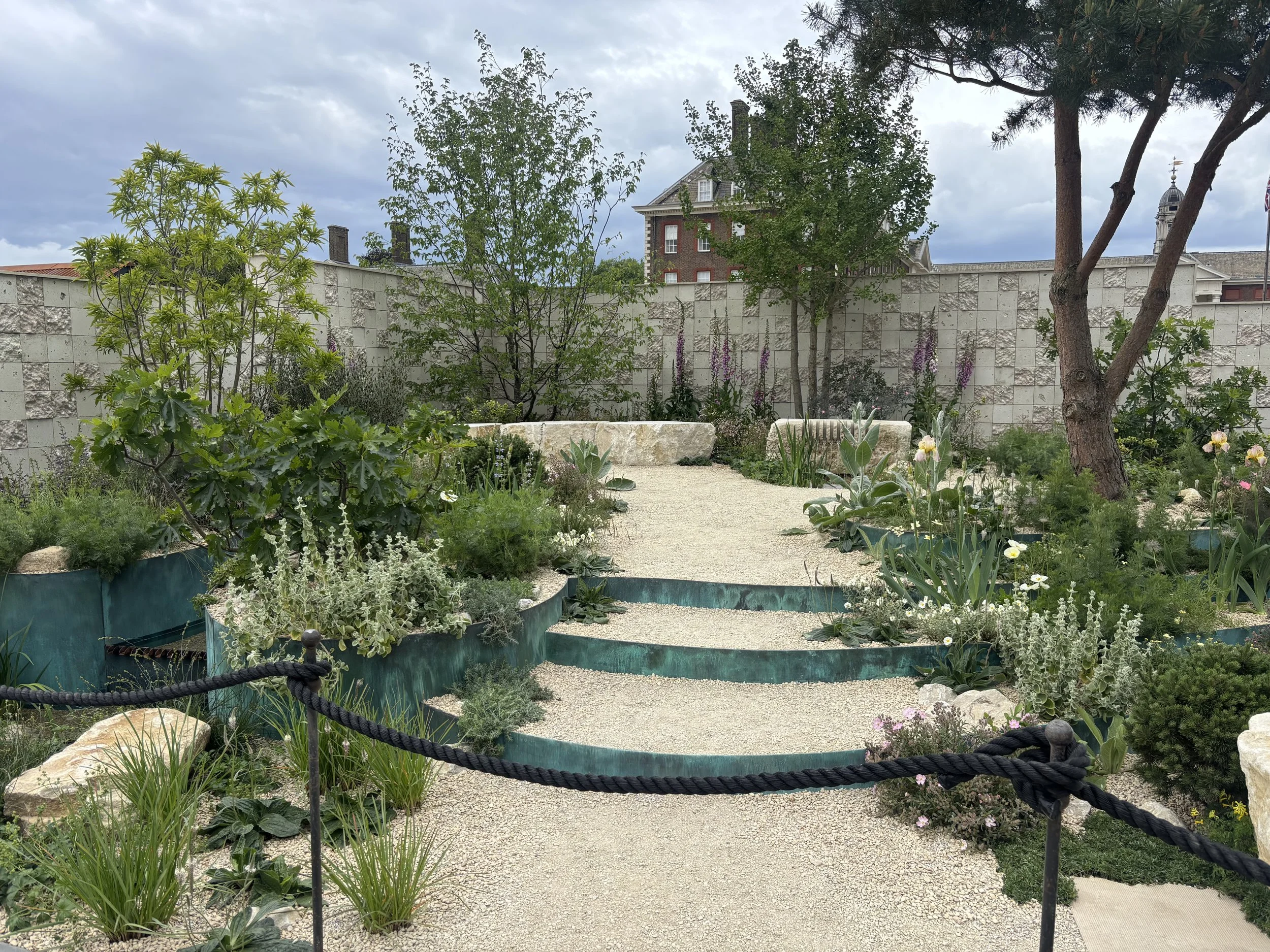
Addleshaw Goddard: Flourish in the City by Carey’s Garden Design, shell-crete was used extensively to construct boundary walls
Chelsea has always acted as a testing ground for new garden materials, and this year sustainability and material reuse remained major themes.
In previous years we’ve seen experimentation with mycelium structures, cork surfaces and low carbon landscape materials. This year, bio based construction materials such as shellcrete and kelp based materials continued that conversation around how gardens can reduce environmental impact while still feeling tactile and beautiful. Recycled and reused materials were also a core theme across many of the show gardens.
What is interesting is that these materials no longer feel experimental in a purely conceptual sense. They are beginning to move into mainstream garden conversations as designers and clients look for alternatives to heavily carbon intensive landscaping materials.
Materials have always been an area of experimentation at Chelsea and are one of the clearest ways garden design reflects the wider geopolitical and economic landscape in which it exists. As transportation costs and material prices continue to rise alongside global uncertainty, reusing materials already on site is becoming increasingly viable both environmentally and financially.
As climate pressures and geopolitical uncertainty look set to remain, local, recyclable and inventive material reuse is likely to become just as important as planting choice within garden design.
What These Chelsea Trends Really Tell Us
Taken together, these trends point towards something bigger than style alone, that we as a soeicty (or at least parts of it), are fundementally shifting our relationship to nature and how we wish to express it.
Gardens are becoming:
less rigid
less formalised
more ecological
more adaptive
more emotionally driven
more connected to place
There is a growing understanding that beauty does not need to come from perfection or control. Some of the most compelling gardens at Chelsea this year felt softer, more responsive and more alive precisely because they embraced complexity, time and change. For me, that is one of the most hopeful directions contemporary garden design can take.
I want to see gardens that are not only sustainable, but genuinely regenerative. Gardens that help us reconnect with the land, and where that connection in turn helps heal the landscape around us. Softer, kinder spaces that are not simply less consumptive, but fundamentally more connected.
We need to take the long view rather than the short one. Personally, I hope the age of the instant impact, overly polished garden is beginning to fade and that we are moving towards something more honest and enduring. The anti AI and easy package.
Partly because of this shift I want to see and partly because I simply love being outside and involved with gardens over time, our business is diversifying to include garden stewardship. This allows us to support local clients in creating and evolving gardens that feel alive, immersive and deeply personal long after the initial build is complete. It is all about process and connection not a destination.
If you are interested in how these ideas might shape your own garden, do get in touch with us to discuss your next project.